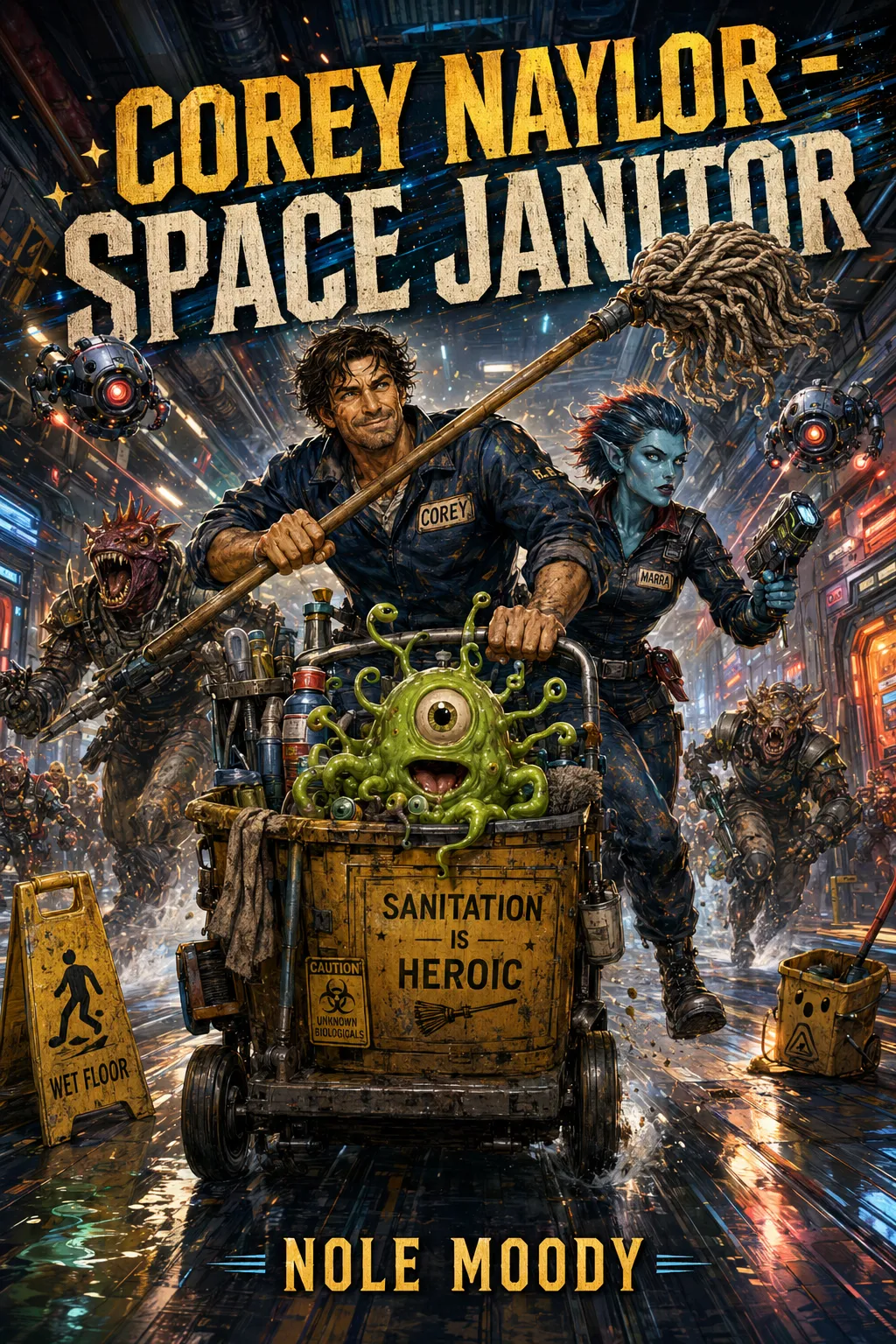
Both books out now
Corey Naylor
Die Hard in Space, with an unskilled janitor.
The pitch
Not everything Nole Moody writes leaks in from Weird Britain. Some of it happens a very long way from Britain, in the maintenance corridors of a starship that has just been boarded by pirates.
Corey Naylor wanted a quiet shift, a working mop, and a day without anyone marking his access card as suspicious. Instead he got armed pirates, a failed security team, and a bucket of cleaning supplies that may not be entirely legal. The pirates came prepared for soldiers. They did not come prepared for the janitor.
No dragons, no portals, and nothing to do with the wider Weird Britain. Just the same instinct for ordinary people trapped in absurd systems, pointed at a spaceship instead of a staffroom.
Two comic science-fiction novels, both out now. Start at the beginning and the whole shift is waiting for you.
The series
Two books, one very long shift
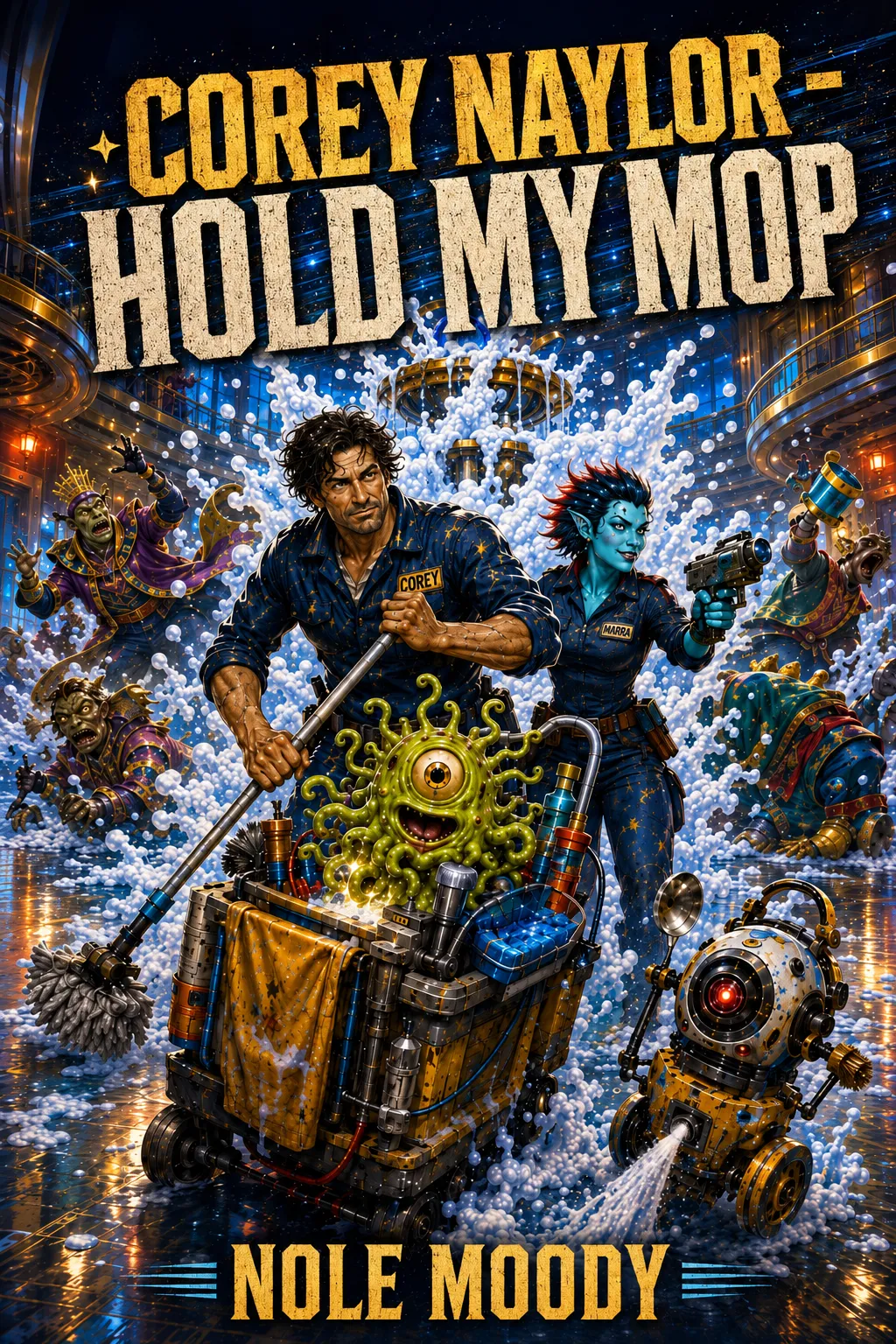
Corey Naylor is one story told in two halves. The boarding begins in Space Janitor and finishes in Hold My Mop, the concluding part of the saga. Both are out, so there is no waiting about. No third book, no dangling shift rota.
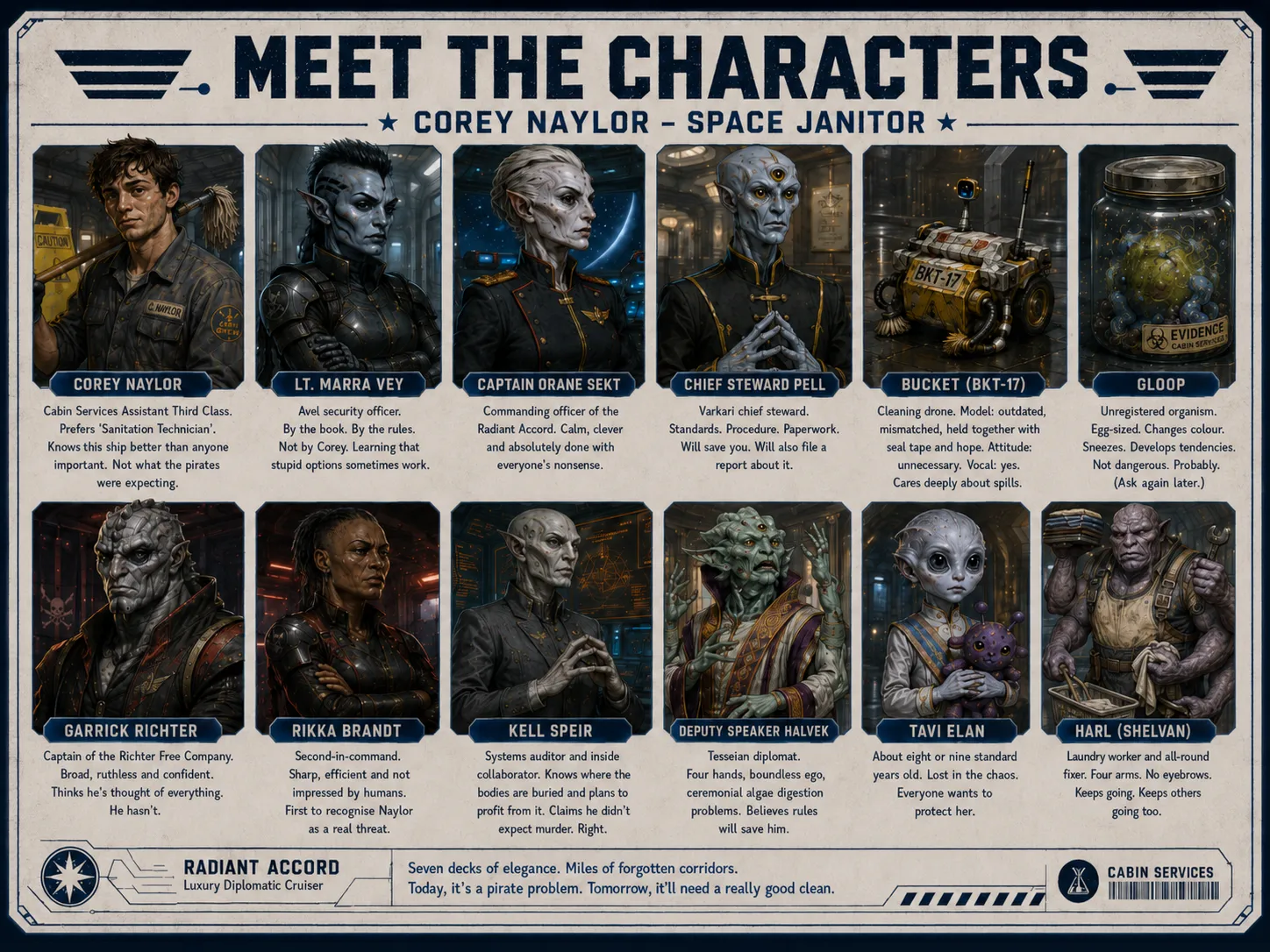
The crew
Meet the characters
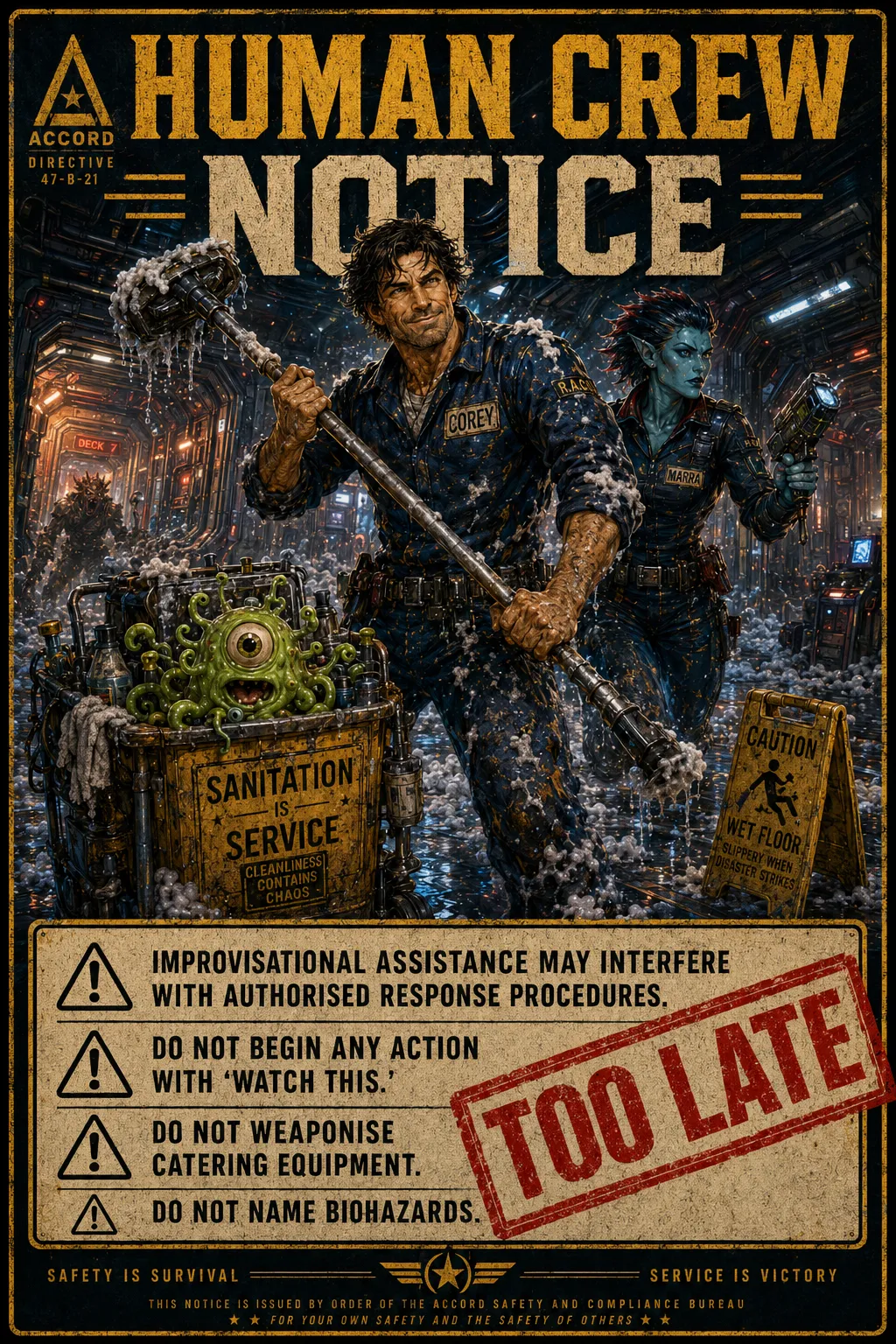
Mandatory reading
Please observe all posted notices
Behind the books
Questions about Corey
- Where did the story come from?
-
I had been writing the Gorzug series for several years (first privately, then publishing on RoyalRoad and finally revised for release on Amazon) and wanted to write something a little more action based as a palate cleanser.
As with Mr. Gorzug I wanted to do a story which lifted up people who often were underappreciated and the original concept was really very simple - Die Hard, in space with a janitor.
You’re just fortunate I didn’t make it a Christmas story. It was tempting.
- Why beige discs?
-
They’re intended to be a play on the perceived blandness of English food, in my mind’s eye they’re pancakes without flavouring.
Their weaponisation was inspired by an English breakfast I was served at a restaurant in Melbourne, Florida. It included Yorkshire puddings so tough they could have been used as hockey pucks.
- Why are the pirates competent instead of comic idiots?
-
Because Corey’s victories only mean something if the opposition is genuinely dangerous. The pirates learn from his tricks and adapt after each encounter. Much of the humour comes from competent professionals being defeated by information their institution considered too unimportant to record.
That is a lesson I learnt from running D&D games. If there is no possibility of failure, there is no real tension. Whether they are readers or RPG players, people eventually lose interest if they never have reason to fear that things might go wrong.
- Why make the hero a janitor?
-
I want my stories to lift up people in overlooked and underappreciated parts of society, rather than punch down at people who already receive too little respect.
Society would struggle to function without janitors, housekeepers, cooks, factory workers and countless other service staff, yet their contribution is often ignored or taken for granted. I did several such jobs when I was younger, including working as a train cleaner, cook and factory operator, so I know how essential—and how undervalued—that work can be.
Corey succeeds because of the skills and knowledge his job has given him, not despite being a janitor. If these stories encourage even a few readers to better appreciate the people doing the work that keeps everything functioning, I’ll consider that a job well done.
- Why does Bucket have a spoon attached to it?
-
Bucket kept colliding with low trays, so Corey pressure-bonded a spoon to its front. The spoon does not prevent collisions, but according to Corey, “it sounds happier”. Like most of Corey’s repairs, it solves a slightly different problem from the one reported.
- Why is “within acceptable tolerance” repeated so often?
-
It represents the difference between a fault being documented and a fault being repaired. Individually, every deferred repair is considered acceptable. Collectively, they form a map of everything that can go catastrophically wrong.
This is partially inspired by my experience as a programmer where bugs are often reported by QA but not fixed because they’re not deemed to be important enough to resolve in the time available. These small, seemingly unimportant issues frequently end up having major unexpected consequences.